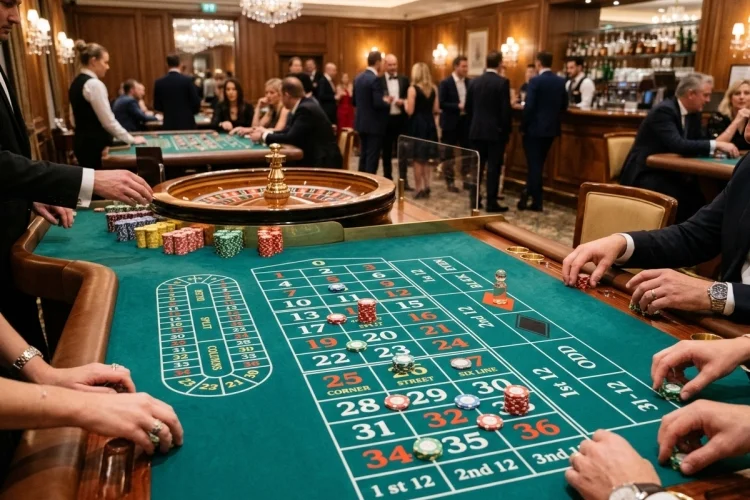
The most confusing part of roulette is usually not the spinning wheel. It is deciding where to place your chips on a table filled with boxes, intersections, columns, and betting labels.
Fortunately, each position represents a clearly defined wager. Once you understand how many numbers a bet covers, its potential payout becomes much easier to remember.
European Roulette uses 37 possible results: the numbers 1 through 36 and a single zero. Players can make focused inside bets on particular numbers or broader outside bets on categories.
This guide explains those options and shows how to calculate your possible return without complicated casino terminology.
Know What You Are Predicting
Every wager predicts where the ball will finish after the wheel stops. You do not need to guess the exact number unless you choose a straight-up bet.
You may instead predict that the result will be red, odd, between 1 and 18, or inside a specific group of numbers.
The more pockets your wager covers, the greater its chance of winning. However, covering more outcomes produces a smaller payout.
Straight-Up and Split Bets
A straight-up wager covers one number. Place the chip directly in the centre of the chosen number’s box.
This bet pays 35 to 1. For example, a winning $2 straight-up wager creates $70 in profit, with the original $2 also returned.
A split bet covers two adjacent numbers. Place your chip on the line separating them. It pays 17 to 1 because two of the wheel’s 37 possible results are covered.
Street, Corner, and Six-Line Bets
A street wager covers three numbers in one horizontal row, such as 7, 8, and 9. It normally pays 11 to 1.
A corner bet covers four numbers that meet at one point. For example, placing a chip where 10, 11, 13, and 14 meet covers all four and pays 8 to 1.
A six-line wager covers two connected rows. It includes six numbers and pays 5 to 1. The standard roulette payout table maintains the same mathematical advantage across these common bets.
Dozens and Columns
A dozen bet covers one of three groups: 1-12, 13-24, or 25-36. Place your chip in the corresponding box marked 1st 12, 2nd 12, or 3rd 12.
Columns also contain 12 numbers, but they run vertically across the layout. Both wagers pay 2 to 1.
A $3 winning dozen bet therefore creates $6 in profit, plus the return of the original $3 stake.
Zero is not included in any dozen or column. When the ball lands on zero, these wagers lose.
Even-Money Bets
Even-money wagers include red or black, odd or even, and 1-18 or 19-36. Each category covers 18 pockets and pays 1 to 1.
These bets are easy for beginners to understand, but they are not true 50-50 wagers. The green zero creates a 19th losing result.
The probability of winning one standard even-money bet is 18 divided by 37, or approximately 48.65%. The remaining 19 pockets produce a loss.
Why the House Edge Is 2.70%
Imagine placing $1 on every one of the 37 numbers. You would spend $37 in total.
One number must win. The successful straight-up wager returns $35 in profit plus the original $1 chip, giving you $36 back.
You spent $37 but received $36, creating an expected difference of $1 for every $37 wagered across that example. One divided by 37 is approximately 2.70%.
An official digital European-style roulette title lists an RTP of 97.30%, which is the opposite side of that calculation.
Avoid Confusing Payout With Total Return
A payout of 35 to 1 describes profit, not the full amount returned to your balance.
If you wager $1 and win at 35 to 1, you make $35 in profit and keep the original $1. The total credited amount is therefore $36.
Online interfaces usually calculate this automatically, but understanding the difference helps you evaluate the displayed result.
Keep Bet Sizes Consistent
Progressive systems often tell players to double their wager after every loss. The problem is that stakes can grow extremely quickly.
Beginning with $2 and doubling after five consecutive losses creates bets of $2, $4, $8, $16, $32, and $64. Recovering earlier losses requires a much larger amount of money than the first wager suggested.
No staking pattern changes the location where the ball lands. Use a small, consistent amount and stop when your preset limit is reached.
European Roulette offers a wide range of bets, but each option follows a simple relationship: covering fewer numbers produces a larger payout, while covering more numbers creates a smaller return.
Straight-up, split, street, corner, and six-line bets appear inside the grid. Dozens, columns, colours, odd or even, and high or low appear outside it. Learn one or two wager types before combining several positions.
Calculate your total stake rather than focusing on individual chips, and never confuse a payout ratio with guaranteed profit. Review the official game information, choose an affordable limit, and use free-play mode to practise placing bets before risking real money.